
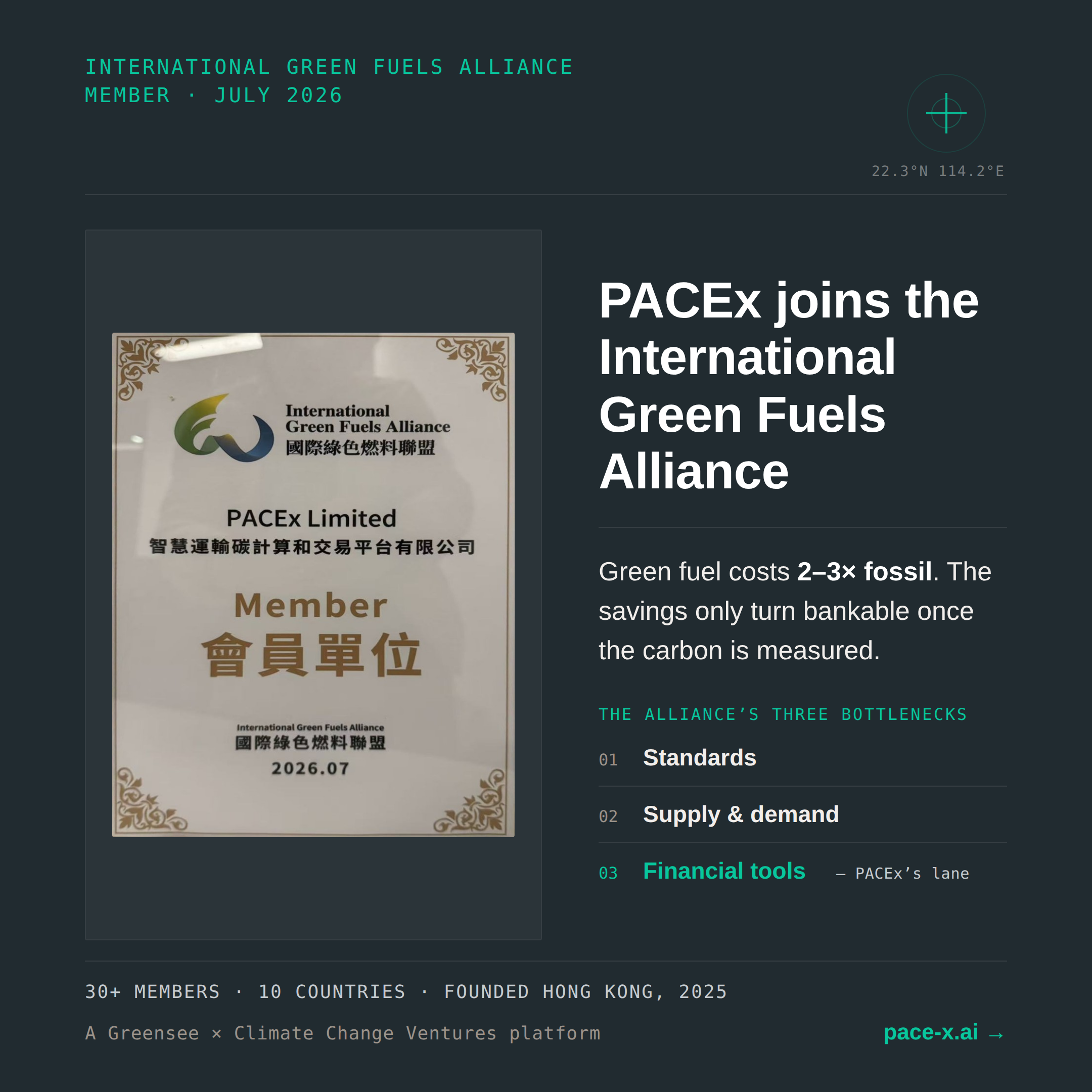
Green shipping fuels cost two to three times their fossil equivalent. The carbon they avoid is worth real money — but only once it is measured to a standard a financier will underwrite. That gap, between avoided emissions and bankable value, is the one the International Green Fuels Alliance was formed to close. It is why PACEx has joined.
PACEx — a Greensee × Climate Change Ventures joint venture · July 2026
The Problem Is Not the Fuel. It Is the Financing.
The engineering case for green methanol, green ammonia and advanced biofuels is largely settled. The commercial case is not. A shipowner switching to green fuel takes on a premium of roughly 2–3× the price of conventional marine fuel, energy-for-energy — a cost that only pencils out if the carbon it avoids can be converted into value: compliance under EU ETS and FuelEU Maritime, a sustainability-linked loan margin, a differentiated charter rate, or a tradable carbon credit.
None of those instruments pay out on good intentions. They pay out on numbers — measured, attributable, and robust enough to survive a lender’s or a regulator’s due diligence. That is precisely where the green-fuel market stalls today.
Three Bottlenecks — One of Them Is Ours
The International Green Fuels Alliance (IGFA / 國際綠色燃料聯盟) was founded in Hong Kong in late 2025, with the support of the Hong Kong SAR Government’s Transport and Logistics Bureau, and now brings together more than 30 organisations across ten countries — classification societies, ports, energy majors and shipowners. It exists to clear the three bottlenecks holding the green-fuel transition back:
No mutual recognition of what counts as “green” across jurisdictions and certifiers.
Production and offtake sit in different places, at different times, with no clearing mechanism.
No trusted way to turn avoided carbon into finance, compliance value or a tradable credit. This is PACEx’s lane.
Standards and supply–demand matching are collective, standards-body work. The third bottleneck — the financial tools — is where a measurement platform earns its place. And every financial tool inherits the credibility of the carbon number underneath it.
What PACEx Brings to the Alliance
PACEx is a transport carbon calculation and trading platform. It reconstructs emissions from the operational signal a vessel already broadcasts, and attributes them to the single voyage, the single berth call, the single tonne of fuel — not to a fleet-average factor. That itemisation is what makes the number bankable rather than merely indicative.
Emissions derived from operational data, aligned to the IMO Fourth GHG Study methodology — not periodic estimates or self-reported returns.
Every tonne traces to a specific voyage or berth call, so a green-fuel saving can be claimed, audited and settled without dispute.
A single dataset that serves EU ETS, UK ETS, FuelEU Maritime and IMO reporting — and the finance decisions built on them.
The same trusted number carries through from carbon accounting to carbon-market and green-finance value — measure, then verify, then trade.
Why the Sequence Matters
A green-fuel market that trades on estimates is a market that will not clear, because no counterparty underwrites a number it cannot audit. Measurement comes first; verification and trading inherit their credibility from it. Within the Alliance, PACEx sits at that foundation — the measured, auditable carbon layer on which mutual standards can settle and financial instruments can be priced.
A green fuel you cannot measure is a cost. A green fuel you can measure is an asset. The difference is the number underneath it.
Joining the International Green Fuels Alliance places PACEx alongside the classification societies, ports, energy suppliers and shipowners working to make green fuel not just available, but financeable — and to position Hong Kong as an international green-fuel trading hub. It is the right room for a platform whose entire purpose is turning avoided carbon into bankable value.
Make your green-fuel savings bankable
Whether you are switching fuel, sizing a compliance position, or building a green-finance case, we will calculate your measured, auditable carbon baseline and walk you through it — attributed to the voyage and the berth call.
Talk to PACEx →or write to contact@pacex.ai
About the Alliance: the International Green Fuels Alliance (國際綠色燃料聯盟) was founded in Hong Kong in late 2025 with the support of the Hong Kong SAR Government’s Transport and Logistics Bureau, and comprises 30-plus members across ten countries. It works to align green-fuel standards, match supply with demand, and connect green finance with carbon markets. PACEx is a joint venture of Greensee and Climate Change Ventures. The 2-3× green-fuel premium is an indicative industry range for green methanol and e-fuels versus conventional marine fuel on an energy-equivalent basis.
